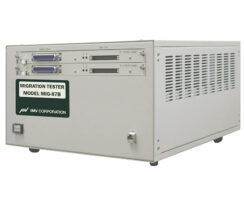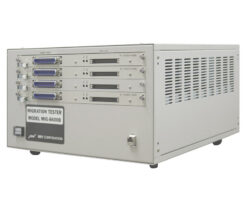
MIG-8600B
A bestseller! This single unit can be used for both low-side and high-side testing.

Migration is an electrochemical failure phenomenon in which, when a voltage is applied in a high-temperature, high-humidity environment, metal ions—such as copper—dissolve, migrate across the insulator and precipitate.
This causes conductive dendrites to form between wires that are normally insulated, leading to short circuits, open circuits and a reduction in insulation resistance.
Due to the miniaturisation, increased density and higher voltages of electronic devices (e.g. EVs and renewable energy), the distance between electrodes is becoming narrower, meaning that the risk of failure caused by migration is higher than ever before.
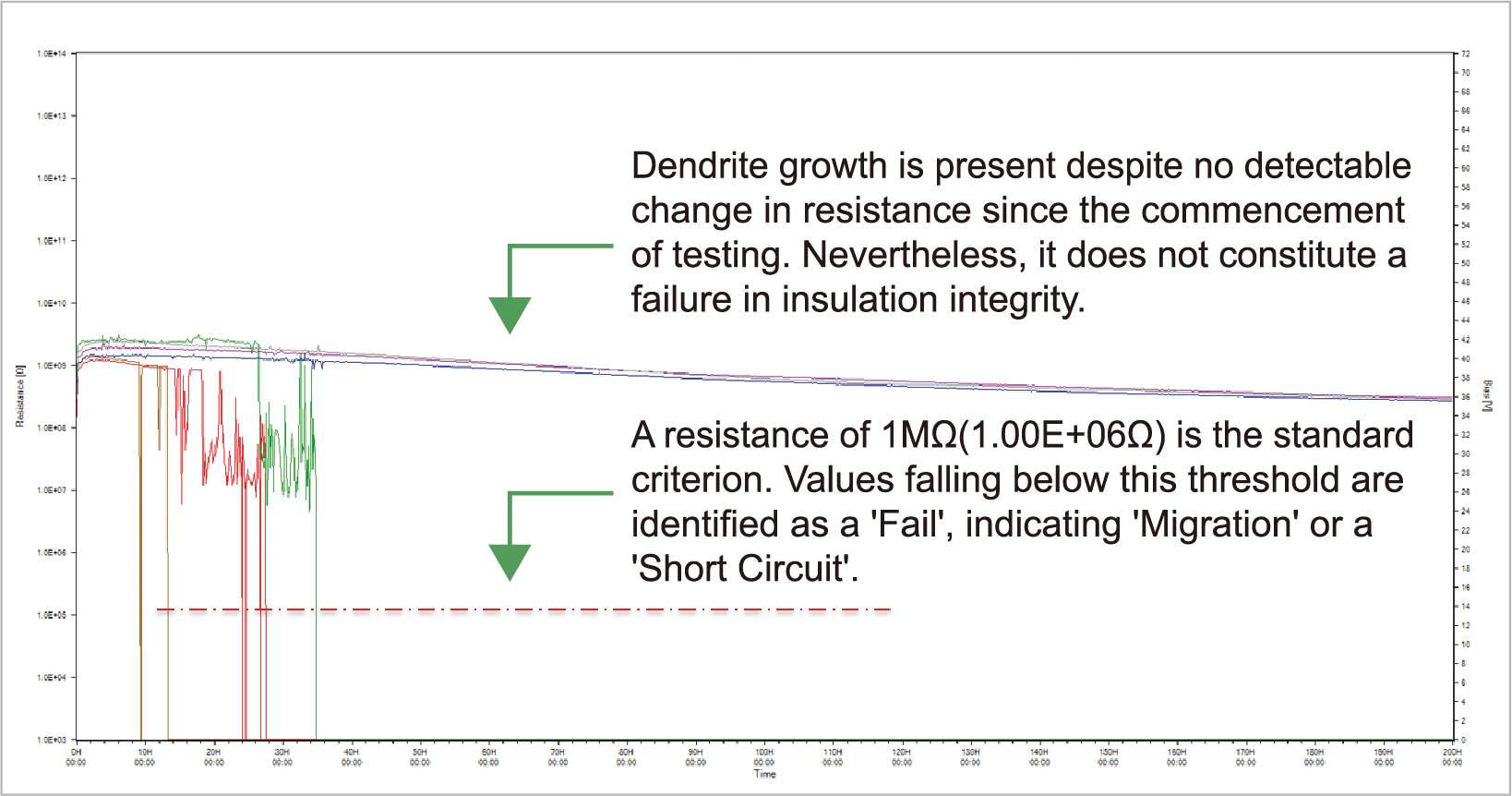
This test evaluates product reliability by continuously measuring insulation resistance in real time whilst applying a voltage stress to the test specimen (such as a printed circuit board).
It plays a key role in preventing product recalls and fire incidents.
| standard | Overview | Applications |
|---|---|---|
| JPCA-ET | Japan Electronics Packaging and Circuits Association standard. Evaluates insulation reliability under Japan’s rigorous environmental criteria. |
Standard evaluation for domestic consumer electronics and industrial printed circuit boards (PCBs). |
| IPC-TM-650 | International test methods established by IPC (USA). Covers a comprehensive range of physical, chemical, and electrical properties of PCBs. | Quality assurance and compliance testing for electronic circuit boards and multilayer boards for the global market. |
| JIS Z 3197 | Japanese Industrial Standard for testing “Soldering Flux”. Evaluates the corrosivity and properties of flux residues. | Selection of soldering materials and verifying chemical stability during the assembly process. |
| IEC 60068-2 | International Electrotechnical Commission standard for environmental testing. Defines various stresses including temperature, humidity, vibration, and shock. | International standard evaluation of environmental durability for electronic components and equipment exported globally. |
| JIS C 60068-2 | The Japanese version of IEC 60068-2. Aligned with international standards to ensure consistency in environmental testing. | Verifying durability against temperature, humidity, and mechanical loads for electrical and electronic products. |
| JASO D001 | Standard established by the Society of Automotive Engineers of Japan. Specifies harsh environmental conditions unique to automotive electronics. | Development and quality evaluation of automotive electronic components for Japanese OEMs and suppliers. |
| ISO 16750-4 | International standard regarding environmental conditions for electrical and electronic equipment in road vehicles (Part 4: Climatic loads). | Climatic durability evaluation required by global automotive manufacturers (OEMs) for vehicle-mounted equipment. |
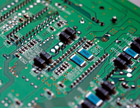
Printed Circuit Boards (PCBs)
Semiconductors

Electric Vehicles (EV)

Electronic Materials
Lithium-ion Batteries (Li-ion)
Glass Substrates
Rigid PCBs & Flexible Circuits (FPC), Glass Cloth, Underfill Materials、Build-up Films
Resin Packaging & Encapsulants , Insulating Inks , Conductive Materials , Adhesives
Interlayer Dielectrics , Cleaning Agents , Solder Resist , Coverlay Films
Plating, Flux, and Etching residues , Contaminants / Foreign Matter , Through-holes & Via-holes
Fine Pitch (Narrow Spacing) , Conductor & Electrode Geometry
Through-hole Clearance , Multi-layer Board Configurations
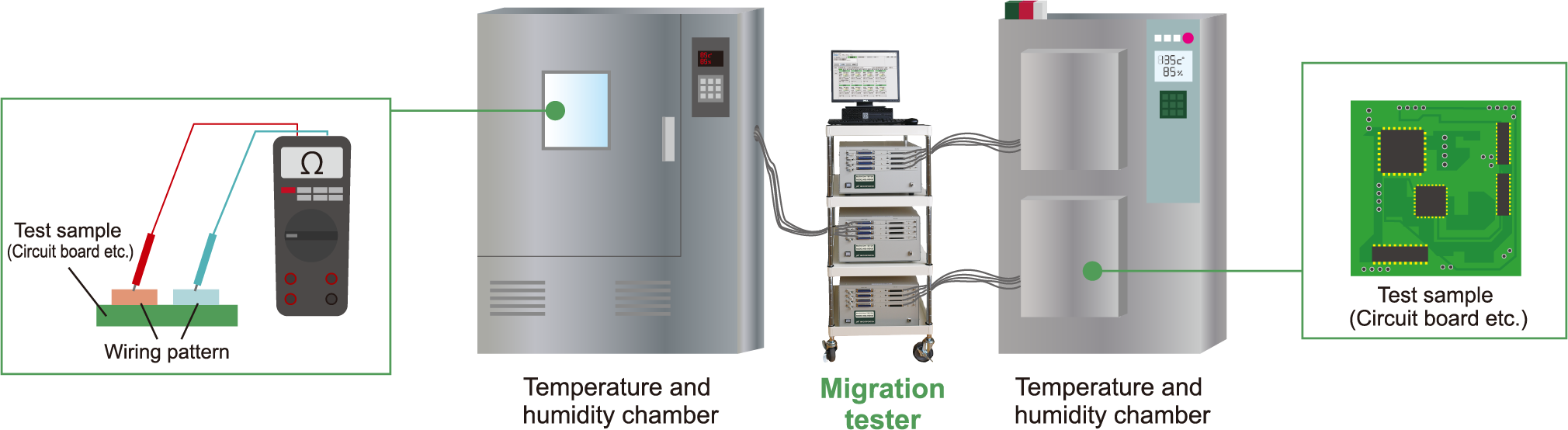
We measure insulation resistance continuously by applying voltage stress to your
samples—such as PCBs—within a controlled high-temp/high-humidity environment.
| Item (Model) | MIG-8600B/32 | MIG-87B |
|---|---|---|
| Applied Voltage | +1.0V to +250V (0.1V increments) | |
| Max Expansion Channels | Up to 256 ch | 16 ch |
| Insulation Resistance Range | 105Ω to 1014Ω (at 100V) | |
| PC Requirements | OS: Windows 11 compatible | |
| Power Supply | AC 100V, 50/60Hz, approx. 100VA | AC 100V, 50/60Hz, approx. 60VA |
| External Dimensions | W 385 × D 432 × H 227 mm(Excluding protrusions) | |
| Weight | Approx. 18 kg (for 32ch) | Approx. 14 kg |
The MIG series has an applied power supply and measurement circuit for each channel separately, so that even if migration occurs in one channel, the other channels are not affected at all.
1-channel block diagram
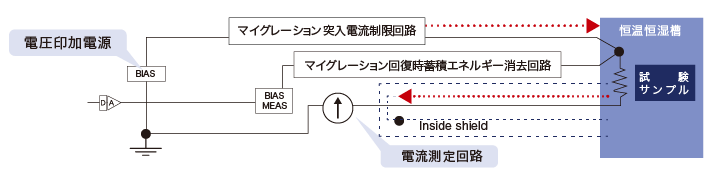
The applied voltage at the individual soldering points for each channel is constantly monitored and controlled as per the set value.
1-channel block diagram
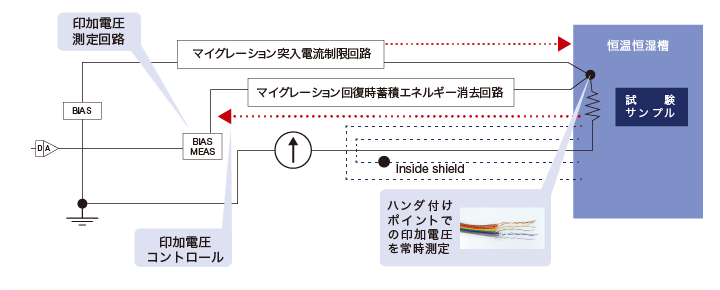
The use of a double-layer active guard cable* cuts out ambient noise and commercial hum. The accuracy of the migration test, which measures weak currents, is therefore greatly improved.
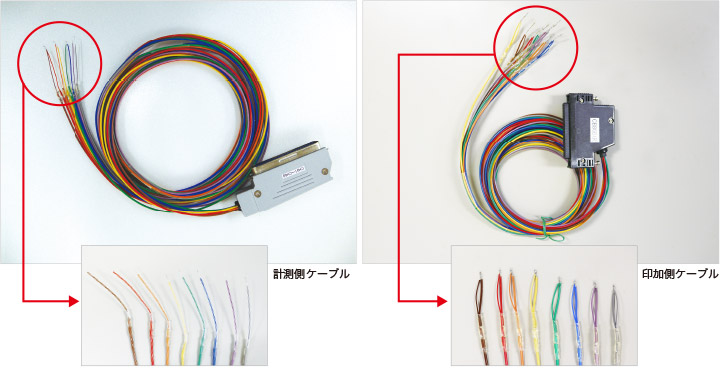
Coaxial cables used for measurement have the following two problems when measuring minute currents.
We avoid these effects as much as possible by employing double-shielded wires in the measurement cable and also providing an active guard function. With this construction, the inner shield wire is controlled to be at the same potential as the measurement line, thereby counteracting the effects of resistance and capacitance between the measurement line and the inner shield wire. This eliminates the effects of (1) and (2) above.

Skilled staff are available for tests that cannot be carried out by other companies.
Available Tests
〒252-0185 870 Hizure, Midori-ku, Sagamihara-shi, Kanagawa, Japan
Please wait a moment for the form to appear.
If the form does not appear, pleasecontact us