

Salt Spray Tests(Combined cycle test・NeutralSalt Spray Tests)
What is a salt spray test?
Corrosion is a primary factor that significantly shortens product lifespans. The salt spray test is a representative corrosion test designed primarily to evaluate the corrosion resistance of metallic materials and surface treatments, such as plating and coatings.
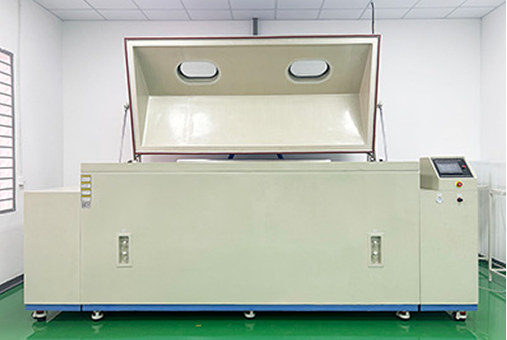
In this test, a saline solution is atomised into a fine mist and sprayed onto specimens over a specified period. By exposing the materials to this environment, we observe the progression of corrosion. Tests are strictly conducted under specific temperature and humidity conditions in accordance with international and domestic standards. This allows for the precise performance comparison of different materials and coatings under identical conditions.
This process is vital for reducing risks during material selection at the design stage and for enhancing product reliability. By evaluating products under conditions that simulate real-world environments, we ensure that high-quality products reach the market. This testing is widely adopted across industries requiring advanced corrosion resistance, particularly in automotive, aerospace, and construction materials.
Primary Objectives of Salt Spray Testing
-
- Evaluation of Corrosion Resistance
To accurately understand the degradation resistance of materials, especially for products used in salt-affected areas or high-humidity environments.
-
- Comparative Verification of Materials and Surface Treatments
To determine the optimal material selection and specifications based on the operating environment and cost considerations.
-
- Service Life Prediction and Quality Assurance
To reduce long-term maintenance costs and ensure product reliability by selecting highly durable materials.
Salt Spray Testing Services by IMV
The salt spray test is generally carried out in accordance with the following procedure.
-
STEP01
Setting the test conditions

The concentration and temperature of the salt water used for the test are set according to the relevant specifications.
Typically, a 5% sodium chloride solution is used (though this may vary, such as 3.5%, depending on the standard). -
STEP02
Specimen Installation and Equipment Operation

Specimens are mounted at a prescribed angle within the spray apparatus.
During this phase, parameters such as spray duration, test chamber temperature, and humidity are strictly controlled. -
STEP03
Progress Observation and Quantitative Analysis

Once the test begins, the progression of corrosion is observed at regular or specified intervals, and surface changes or the degree of corrosion are recorded.
After the test is completed, the specimens are removed for visual evaluation and measurement using precision instruments to quantitatively analyse the extent of corrosion.
Service Details
We select specimens appropriate for the evaluation target (metals, coatings, etc.). To obtain accurate measurement results, specimens must be prepared with a specific shape and dimensions based on the standards. In preparing the solution, we use high-purity sodium chloride and manage the laboratory environment to minimise the effects of changes in temperature and humidity.
Typically, in Neutral Salt Spray (NSS) testing, the chamber temperature is maintained at approximately 35°C.
Throughout the test, periodic observations are conducted to verify the state of corrosion. Upon completion, we perform a detailed analysis of the specimen’s condition and compile the evaluation results into a comprehensive report.
Supported Standards
| Standards | Description |
|---|---|
| JIS Z 2371 | The most fundamental standard for salt spray testing in Japan |
| JIS C 60068-2-11 | Continuous spray test for electrical and electronic products |
| JIS C 60068-2-52 | Combined cycle test alternating between “salt spray” and “high-humidity storage.” |
| JASO M 609 | Combined cycle test (CCT) for automotive parts. |
| JASO D014-4 | Environmental testing standard specifically for automotive electronic equipment. |
| NDS C 0110E | Testing standard for electronic components of defence equipment. |
Types of Salt Spray Tests and Facilities
Our facilities offer two types of salt spray testing tailored to your objectives and expected environments: Neutral Salt Spray (NSS) and Combined Cycle Testing (CCT).
Note: Please be advised that we do not support Acetic Acid Salt Spray (AASS) or Copper-Accelerated Salt Spray (CASS) testing.
Neutral Salt Spray Test (NSS)
The most standard method. It uses salt water adjusted to a neutral pH and is adopted across all industrial sectors as a “yardstick” for evaluating the corrosion resistance of a wide range of materials.
| Test Method |
A 5% concentration sodium chloride solution, with the pH strictly controlled between 6.5 and 7.2, is sprayed onto specimens for a specified duration to quantitatively evaluate corrosion resistance. |
|---|---|
| Main Standards | JIS Z 2371,JIS K 5600-7-1. |
| Applications | Widely used in industry to verify the basic corrosion progress on base metallic materials or surfaces with anti-corrosion coatings. |
Combined Cycle Test (CCT)
This method involves alternating between different environmental conditions, such as “salt spray,” “humidity,” and “drying.” Since it can apply loads similar to the actual corrosion processes occurring in outdoor environments, it allows for more practical durability evaluation.
| Test Method |
By repeating cycles of environmental conditions (salt spray, humidity, drying) in accordance with each standard, this method accelerates the corrosion process of the specimen to rigorously evaluate its resistance. |
|---|---|
| Main Standards |
JIS H 8502 (systematic evaluation of plating layers), JIS K 5600-7-9 (verification of anti-corrosion performance for paints and coatings). |
| Applications |
Serves as a “standard index” for confirming the corrosion resistance of general metal products and painted surfaces. Its effectiveness is proven in fields ranging from basic quality assurance to the development of new materials. |
Judgment Criteria and Evaluation Items
Judgment criteria for salt spray tests are not uniform; they are often evaluated based on international standards such as JIS, ASTM, and ISO, or individual standards agreed upon with the customer. There are three representative evaluation methods
-
- Appearance Observation (Visual Evaluation)
Detailed inspection for the occurrence and colour of rust, as well as any blistering or peeling of the coating.
-
- Rating Number Method
A method of objectively grading the corrosion area on a numerical scale (0 to 10) by comparing it with standard diagrams (sample charts).
-
- Corrosion Weight Loss Method
Measuring the difference in mass before and after the test to quantitatively calculate the amount of metal lost due to corrosion.
Applications of Salt Spray Testing
Main applications of salt spray testing
-
- Automotive
Verifying the long-term corrosion resistance of chassis and engine parts. Essential for confirming the effectiveness of anti-rust coatings and developing more durable components.
-
- Aerospace, Defence and Marine
Contributing to the reliability of structural materials and surface treatments expected to operate under extremely harsh environments.
-
- Construction Materials
Evaluating the corrosion resistance of metal components used in exterior materials and foundations. Utilised for material selection aimed at extending the lifespan of buildings.
IMV Test Centre for Outsourcing Salt Spray Tests
At IMV, we offer advanced salt spray testing services at the Japan Advanced Reliability Evaluation and Testing Centre in Iruma City, Saitama Prefecture.
-
e-Test Centre Japan

Our centre is one of the premier reliability evaluation facilities in Japan. In addition to standalone salt spray testing, we offer “package evaluations” that combine vibration testing and environmental testing. Through the provision of high-quality EMC testing and technology, we contribute to the evaluation of cutting-edge technologies in the Aerospace, Defence, and Space sectors.
-
Thailand Test Laboratory

We provide support not only for salt spray testing but also for the development of test conditions, vibration and shock testing, and other environmental tests, as well as anti-vibration design and measures to address any failures in testing. We also offer functional evaluation of electrical systems using a range of measuring instruments.
-
Ho Chi Minh Test Laboratory

We can offer that its capabilities to provide a complete one-stop testing service within Vietnam, enabling us to deliver efficient services to our customers.
Test cases
Inquiries
Please wait a moment for the form to appear.
If the form does not appear, pleasecontact us